
Tracing past and present biomass burning events is invaluable for research relating to air quality and human health, climate change monitoring, natural fire regimes, past vegetation changes, and more. These events can be traced in a multitude of ways, with one method being the identification of particular chemical markers that are released during biomass burning events, such as those derived from the burning of cellulose/hemicelluloses (levoglucosan and its isomers), lignin (e.g., vanillic acid, syringic acid, para-hydroxybenzoic acid), or resin acids (e.g., dehydroabietic acid or abietic acid). Due to the broad compositional differences between hardwoods, softwoods, and grasses/graminoids, the ratios between these chemical markers will change in a predictable manner. Therefore, the relative proportions of these compounds (“fingerprints”) measured in aerosols may indicate the type of biomass originally burnt. This information is useful for source tracing, as well as historical vegetation reconstructions if measured in sinks like ice cores or sediment cores.
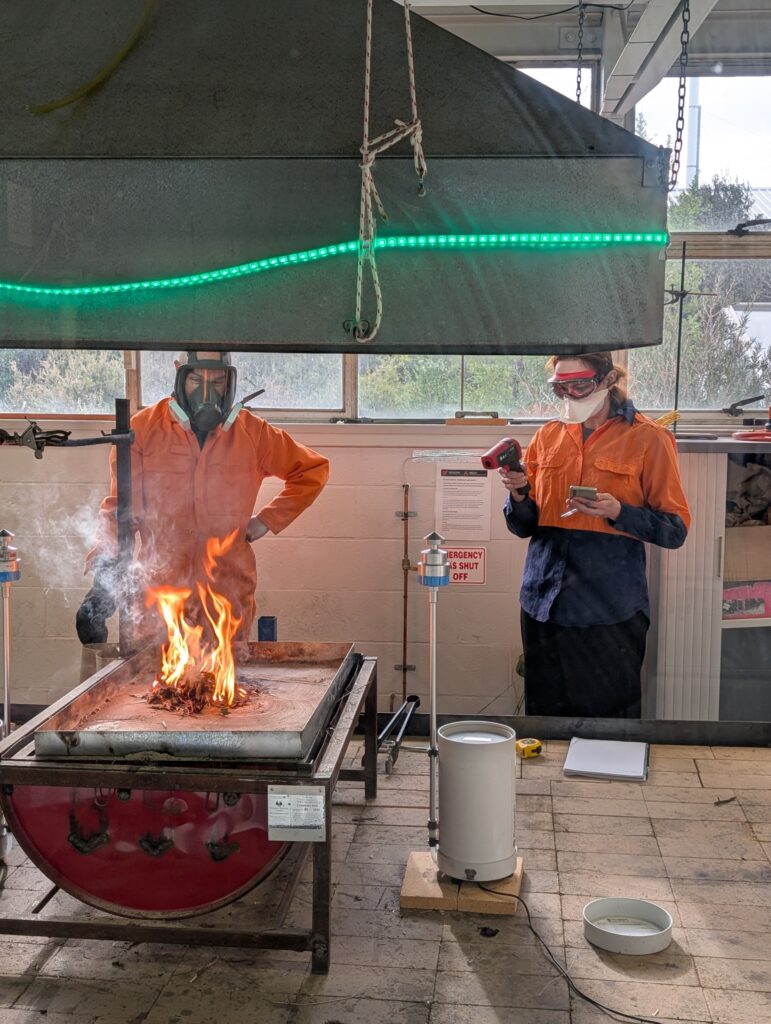
Working with researchers from HyTECH a series of single species burns of softwoods, hardwoods and grasses found in Tsamania were conducted. Species burnt included softwoods such as Pine (Pinus radiata), Oyster Bay Pine (Callitris rhombodea); hardwoods such as Blue Gum (Eucalyptus globulus), (Eucalyptus viminalis); and grasses and other graminoids such as Poa, Sagg (Lomandra longifolia) and (Lepidosperma laterale). Each species was burnt for 20-30 minutes with smoke captured on filters through Aerosol monitoring equipment. Aerosol filters were then analysed a hydrophilic interaction liquid chromatography (HILIC)-based separation method, coupled with triple quadrupole mass spectrometry, that is capable of separating and quantifying all of our target compounds.
Preliminary finding show some differentiation between the compounds produced by hardwoods, softwoods and grasses/graminoids. Additional burns in early 2026 will further clarify these differences.


 Scott Foyster
 Meagan Porter